Open almost any revision app and the first thing it does is ask you a question.
You have not been taught anything yet. You guess. A red cross appears, perhaps with a sad little sound. The app tells you the right answer and moves straight on to the next question, about something else you have not been taught.
Do that ten times in a row and a child learns exactly one thing: "I am bad at this." Which is a strange lesson to charge money for.
Tutorio does it the other way round. It explains first. Here is the opening minute of a real GCSE Drama lesson, exactly as a student sees it.
It starts with what their tutor set
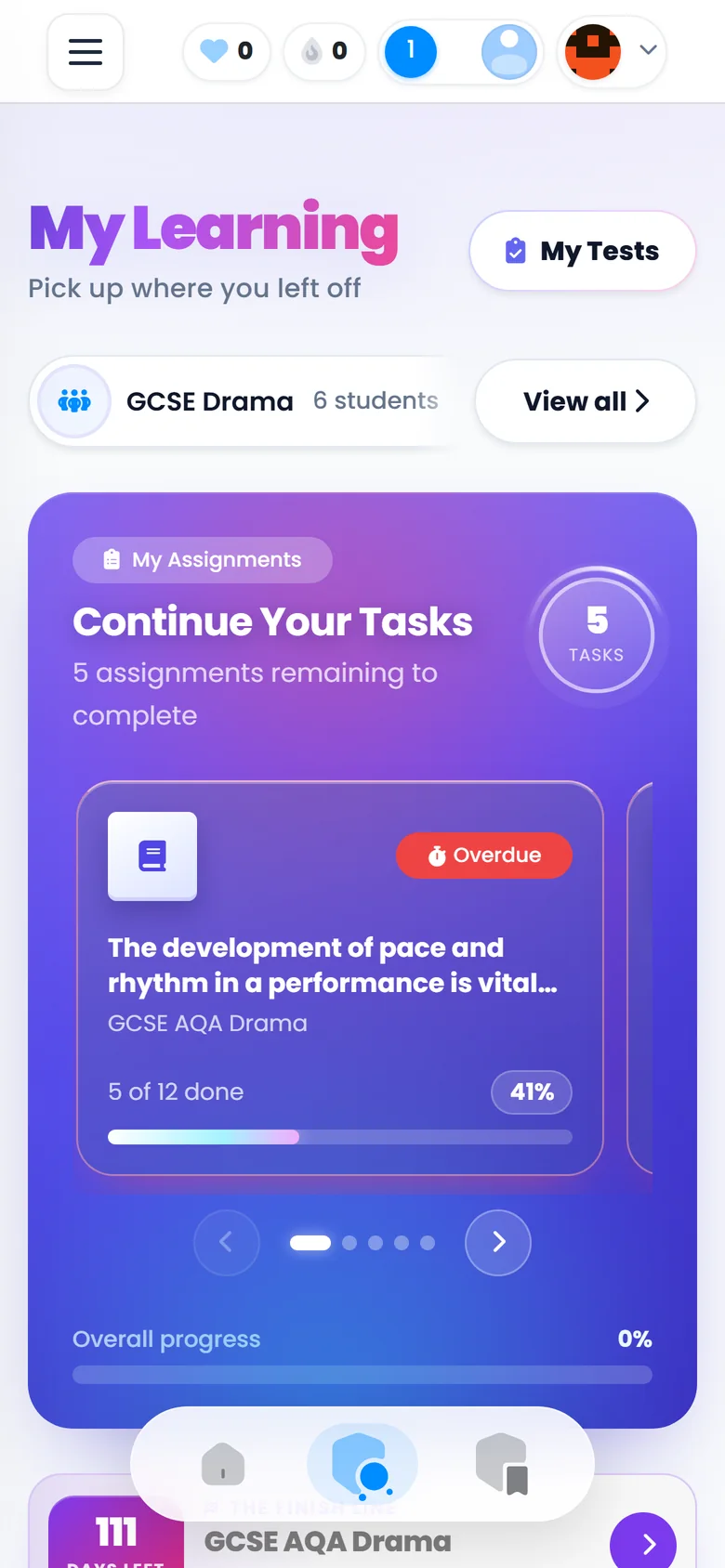
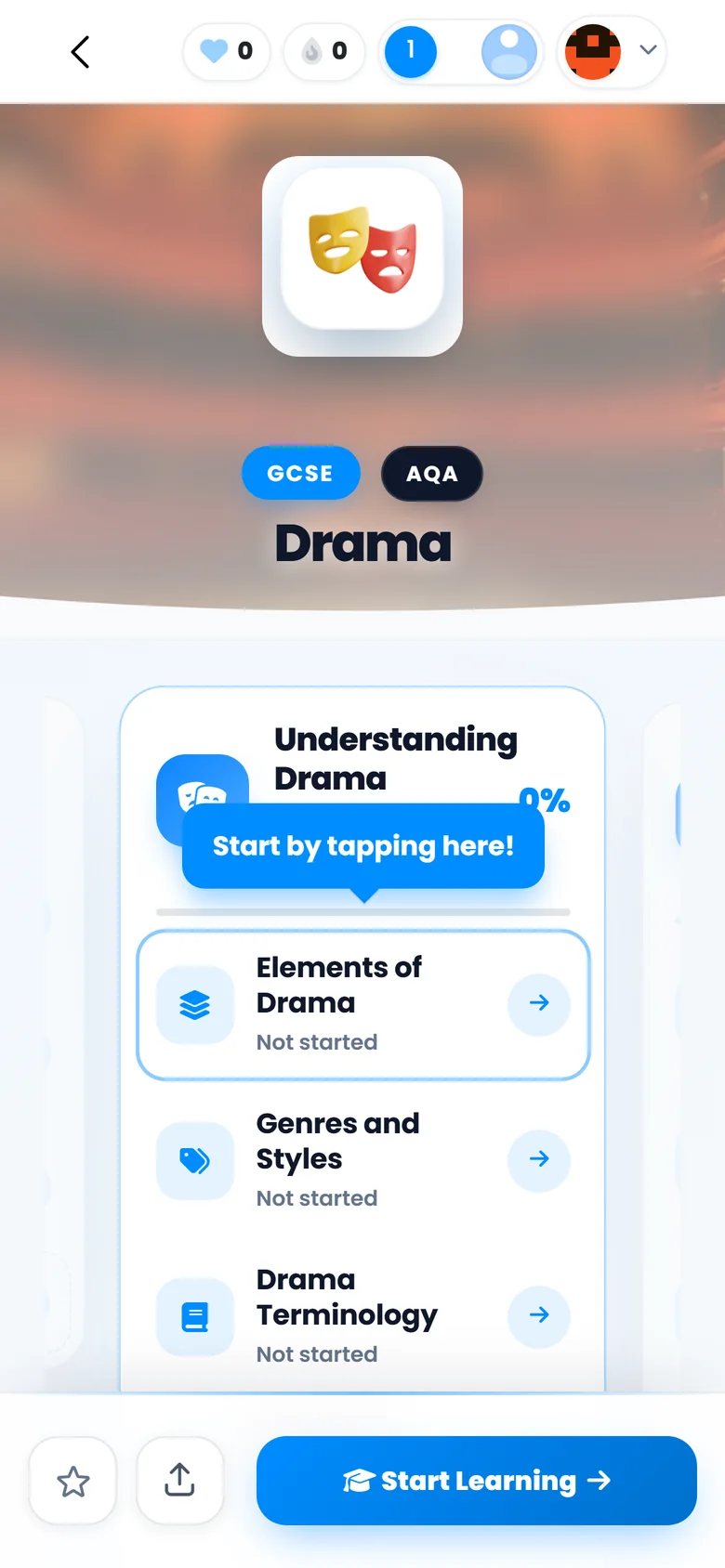
The home screen is called My Learning, and it does not open on a catalogue of four hundred courses. It opens on this student's class and the work their tutor has asked them to do.
Tap into the course and the topics are laid out as cards. On the first one there is a bright bubble: Start by tapping here! It is a tiny thing, and we would not ship without it. A new student should never have to stare at a screen wondering what they are meant to press.
Card one does not ask anything
A lesson is a short run of cards with a progress bar across the top. This one reads 0 / 5, with five to go.
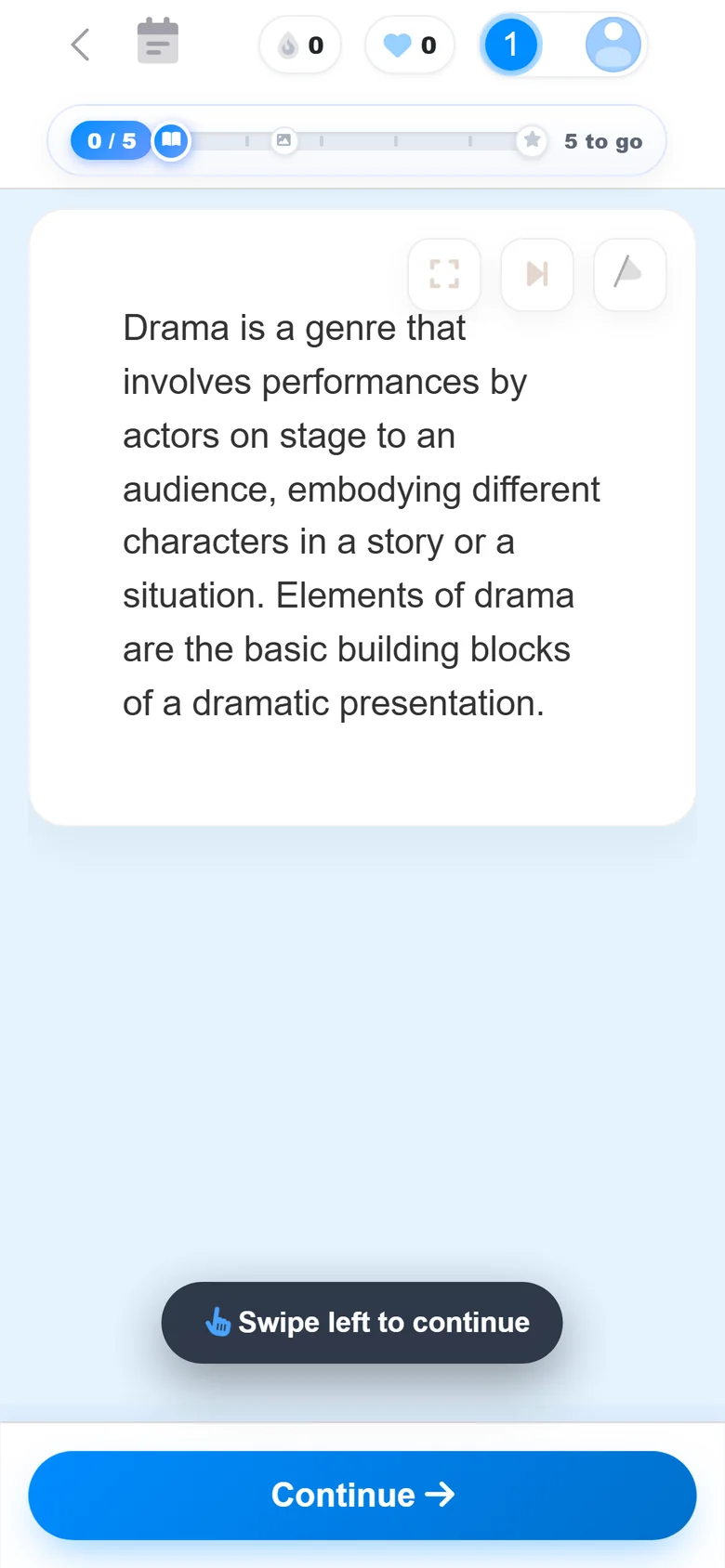
The first card is two sentences about what drama is. No question. Just a clear explanation, sized for a phone, and a hint at the bottom that says to swipe left to continue.
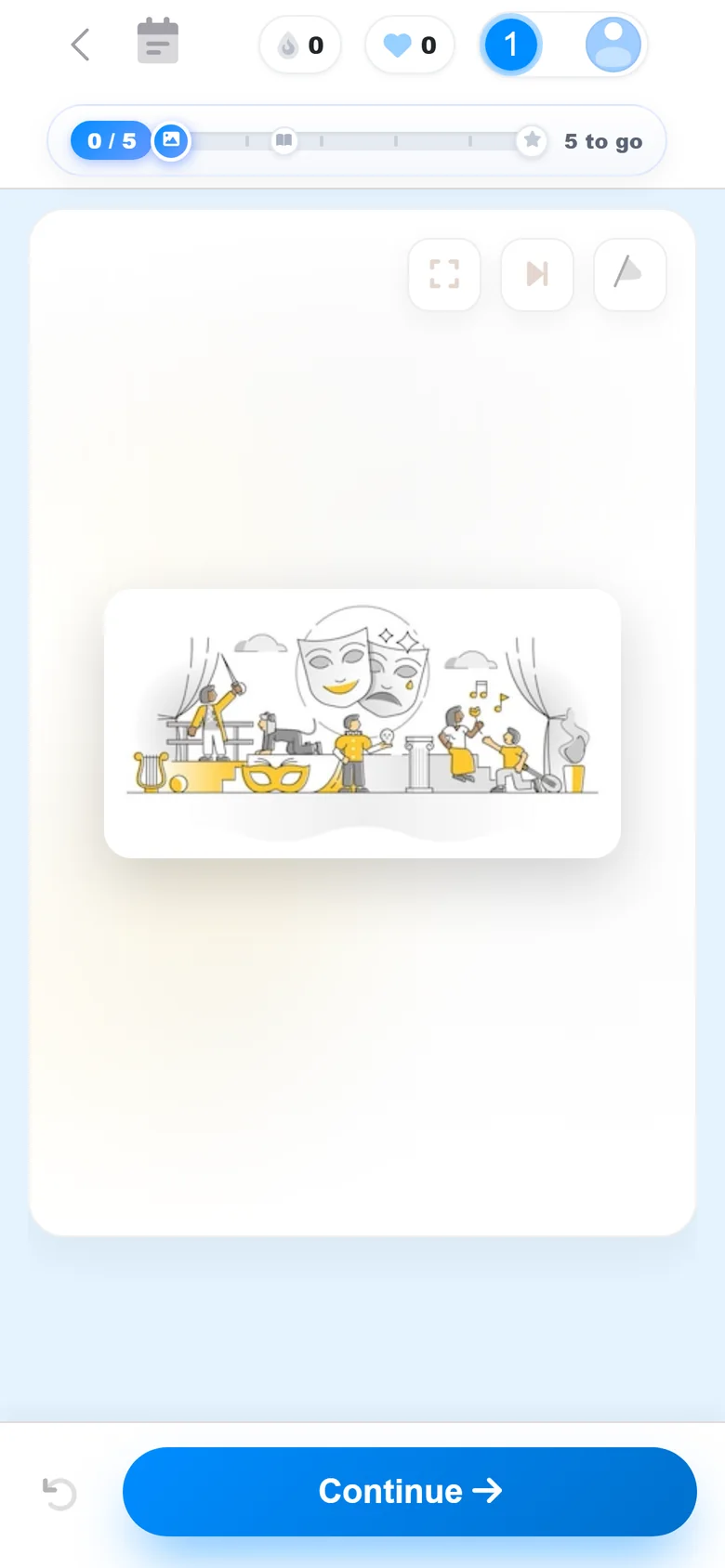
The second card is a picture of a stage. The third introduces the first key term, Plot, and gives it a dotted underline. Press and hold any word a student does not know and a definition appears, chosen for the sentence they are reading. Nobody has to leave the lesson to look something up, which matters, because nobody who leaves a lesson to look something up ever comes back.
Now it asks. About that.
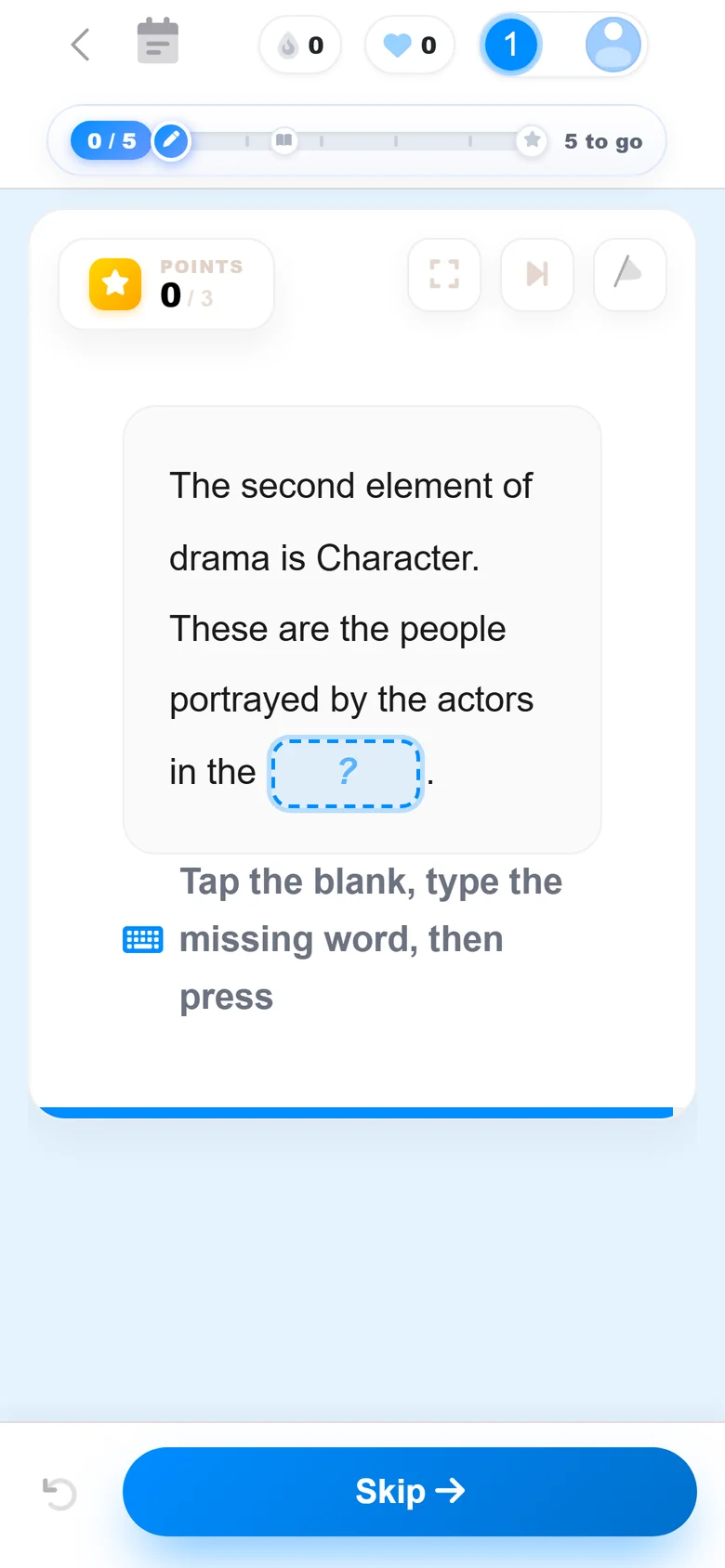
Only on the fourth card does a question turn up, and look at what it is: The second element of drama is Character. These are the people portrayed by the actors in the... with a gap to fill.
It is asking about the thing it just taught. That is the entire trick, and it is astonishing how rarely it is done.
If a student gets a question wrong, it should be because the idea did not stick. Never because nobody told them.
Not every question is a gap to fill. Others ask students to choose, match pairs, put steps in order, drag labels onto a diagram or sketch an answer. Ten identical quiz questions in a row is how you teach a child to stop reading.
What happens when they get it wrong
A wrong answer costs a heart, and a hint appears. Hearts refill on a timer, so a short break brings a student back, which is rather the idea.
One detail for the technically curious, and for anyone who has taught a clever fourteen-year-old. Answers are marked on Tutorio's servers, not on the phone. The right answer is simply not in the page for an enterprising student to dig out. We mention it because some of them will try, and we respect the effort.
The same rule, one level up
At the end of a topic comes a Review: a short mixed check on what has been covered. We call it Review, not a test, on purpose. It is not timed, it does not cost hearts, and you can take it again.
And it follows the same rule. When a tutor sets a Review for a class, it is built only from the lessons that class has actually been taught. Nobody loses a mark for a subtopic they have not reached.
For tutors, that is what makes the score worth reading. A low mark means something did not land. It does not mean your scheme of work is in a different order from someone else's.
Why we are stubborn about this
Because it is kinder, and because it is more honest. But mainly because it is simply how good teaching works. Explain. Show an example. Check they have got it. Move on. Every tutor reading this does it on instinct.
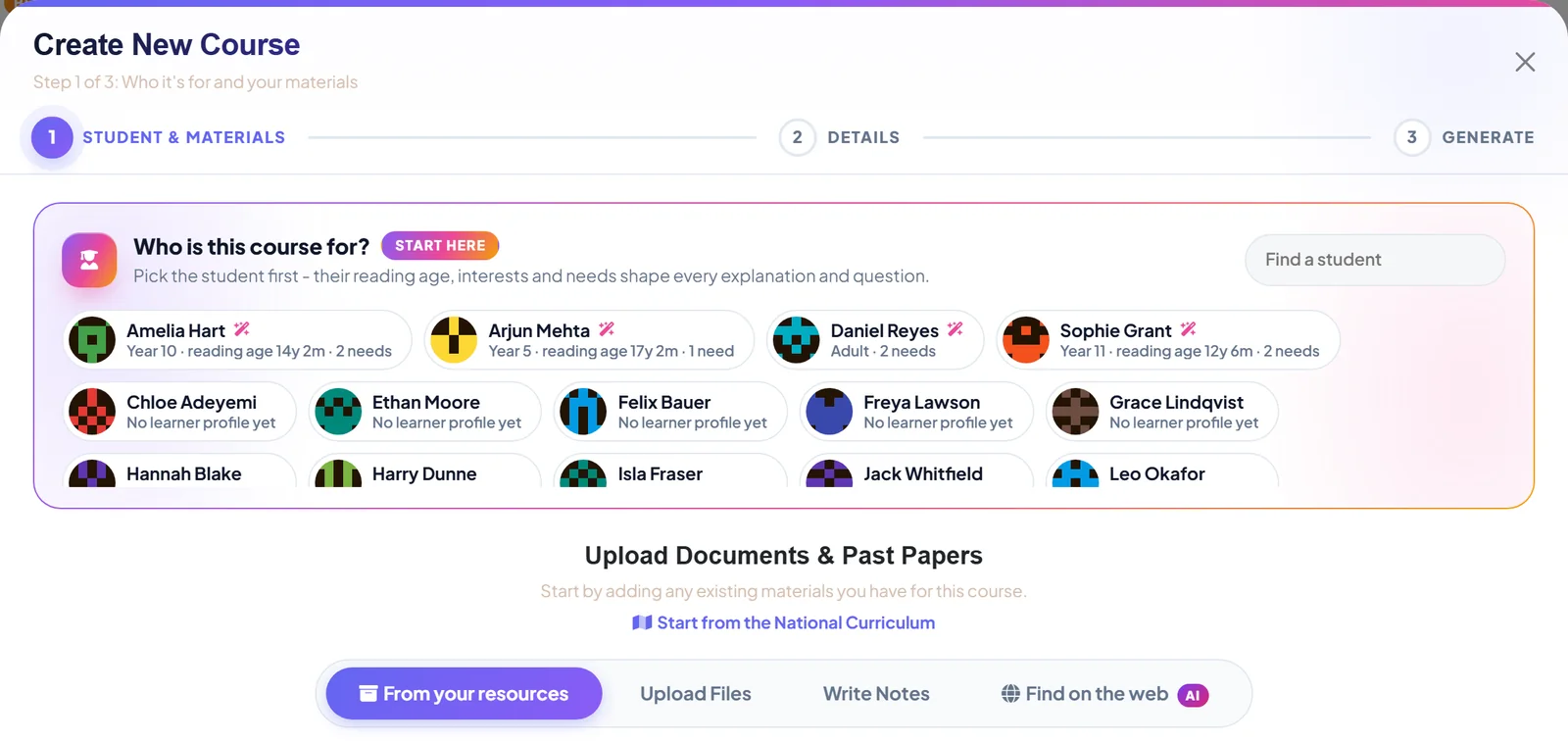
The only odd thing is how much software forgot. When a tutor builds a course with the course wizard, this ordering is not left to chance: every lesson is arranged so the teaching comes first.
Questions people ask
How does a Tutorio lesson work?
A lesson is a short run of cards with a progress bar across the top. Teaching cards come first: an explanation, a picture, a key term. Questions follow, and they ask about what was just taught.
What happens when a student gets a question wrong?
It costs a heart and a hint appears. Hearts refill on a timer, so a short break brings a student back.
What is a Review?
A short mixed check at the end of a topic. It is not timed, it does not cost hearts, and it can be taken again. When a tutor sets one for a class, it is built only from the lessons that class has been taught.
Can students find the answers hidden in the page?
No. Answers are marked on Tutorio's servers, not on the phone, so the right answer is not in the page to dig out.
Is Tutorio free for students?
Yes. Students never pay for practice, Reviews or live lessons. You can browse the courses and try a lesson.

Written by the Tutorio team. We build Tutorio, so these posts describe the product as it is today. Every screenshot is a real capture of the app, and anything that changes gets an updated date. Spotted something out of date? Tell us.