Ask a Year 10 when their exam is and you will get one of two answers. "Ages away." Or, a few months later, "oh no."
There is very little in between, and the in-between is where all the learning is supposed to happen. "The summer" is not a date. It does not get closer. It just sits there being vague until suddenly it is next Tuesday.
So every class in Tutorio gets a finish line.
One date, and everything hangs off it
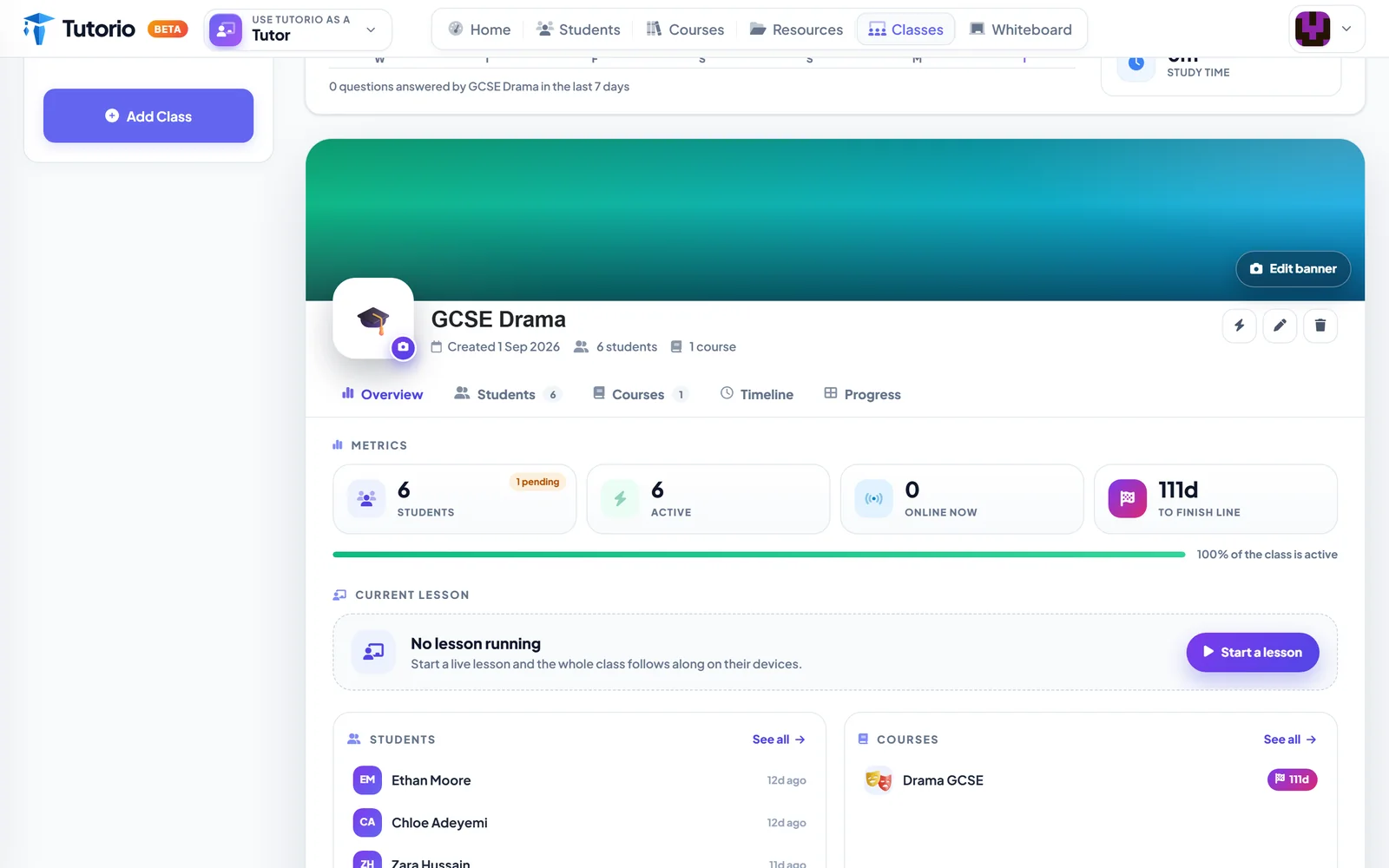
When you set up a class you give each course an exam date. That is all we ask for. From it, Tutorio works out a pace: how many lessons a week will get this class to the end with time to spare.
Then it puts the countdown where nobody can miss it. On your class page, as one of four numbers at the top. And on every student's home screen, as days to go.
111 days is a number you can do something about. "The summer" is a number you can only worry about.
The other tiles are worth a glance too. Six students, six active, a bar underneath reading 100% of the class is active. And a button that says Start a lesson, in case 111 has just focused your mind.
Ahead, on track, behind
Because there is a pace, there is something to be ahead of or behind. You can see which students are ahead, which are on track and which are slipping, while there is still time to do something gentle about it.
That matters more than it sounds. The worst conversation in tutoring is the one in April that should have happened in January. A finish line is how you get to have it in January.
Students get the same honesty. They see the lessons that keep them on pace, not a mountain. And when the exam is close, their reminders mention it, so a nudge reads as "three weeks to go" and not as noise. A date is also step one of a revision timetable that survives a real week.
Now add a little competition
A date gives a class a reason to keep going. A leaderboard gives them a reason to keep going tonight.

On the Deliver page there is a Leaderboard tab. Top three on a podium, a crown for first, stars and levels for everyone.
We know leaderboards divide opinion among teachers, and for good reason. Done badly, they reward the students who were already winning. So notice what this one counts. Stars are earned on the work you deliver to the class, and they add up across all of it. Every ten stars is a new level, so there is always a next rung within reach. A student who works steadily through everything you set can out-climb a naturally quick one who skips half of it.
That is a race worth running. And in a small tutoring group, where everyone knows everyone, "Leo is forty stars ahead of you" is a sentence with real power.
You know your students. Some groups light up at a podium and some would rather not. The finish line works on its own, with or without the race.
Why a line, again
If you have read our post on the dashboard, you will have noticed we like lines. This is the same instinct pointed at students.
Children are not bad at working. They are bad at working towards something they cannot see. Give a class a date, a pace, and somewhere to stand on the way, and "ages away" quietly turns into "111 days, and I am ahead".

Questions people ask
How do I add an exam countdown for my class?
Give each course in the class an exam date when you set the class up. Tutorio shows the days to go on your class page and on every student's home screen.
How does Tutorio know if a student is falling behind?
From the exam date it works out a pace: how many lessons a week get the class to the end with time to spare. You can then see which students are ahead, on track or behind.
How do students earn stars on the class leaderboard?
Stars are earned on the work you deliver to the class, and they add up across all of it. Every ten stars is a new level.
Does the countdown work without the leaderboard?
Yes. The finish line works on its own, with or without the race. You know which of your groups would light up at a podium.
Written by the Tutorio team. We build Tutorio, so these posts describe the product as it is today. Every screenshot is a real capture of the app, and anything that changes gets an updated date. Spotted something out of date? Tell us.